
Raleigh's luxury homebuyers are among the most technology-forward in the Southeast. With the Triangle's robust technology employment base and a growing cohort of high-earning professionals relocating from coastal tech hubs, expectations for smart home features in Raleigh's $1 million-plus market are advancing at a pace that is reshaping what builders and sellers must deliver to compete.
North Carolina's Smart Home Moment
In January 2026, SKYX Platforms announced it would supply its all-in-one smart home platform — built on the NVIDIA AI ecosystem — to Lake Shore Reserve, a new 140-home luxury waterfront community in Granite Falls, North Carolina. The development sits adjacent to Microsoft's upcoming 1,385-acre mega-campus. The announcement signals North Carolina's emergence as a national testing ground for the most advanced residential technology infrastructure, with over 10,000 units of AI-enabled devices — ceiling lighting, ceiling fans, recessed lights, outdoor wall lights, emergency systems — deployed across a single luxury community.
This is the context in which Raleigh's luxury buyers are now evaluating properties. AI-integrated smart home systems are increasingly a baseline expectation, not a premium differentiator. The question for sellers is no longer whether to invest in smart home technology but which systems will satisfy the most sophisticated buyers entering the Triangle's luxury market.
Feature 1: Unified Whole-Home Control
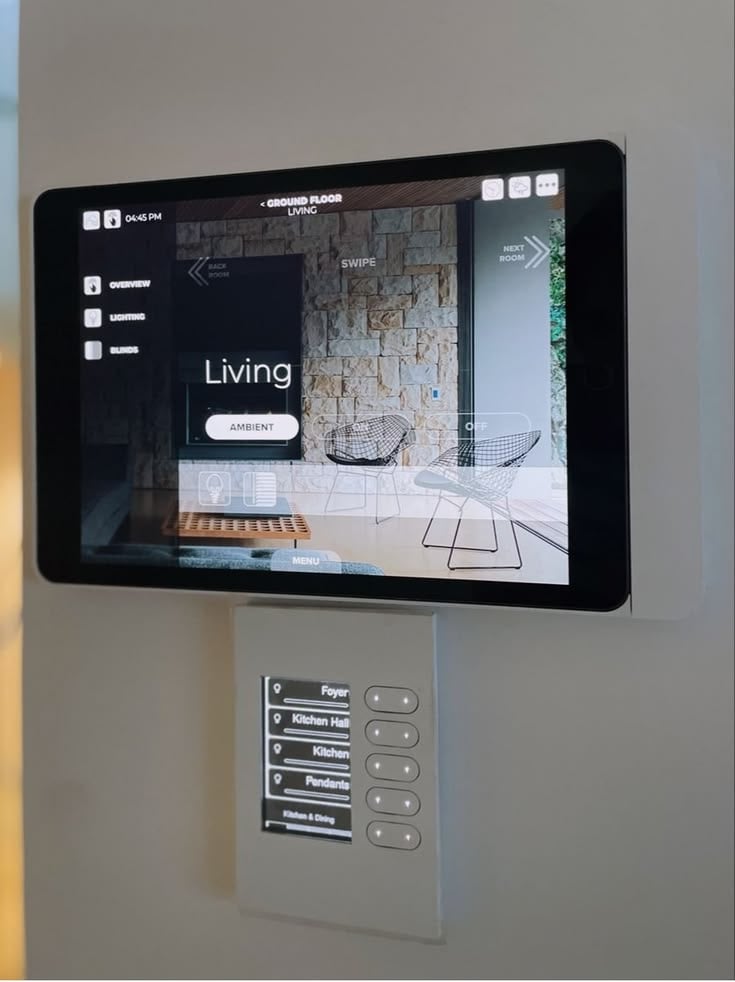
The most consistently cited smart home priority among Raleigh luxury buyers in 2026 is not any individual feature — it is unified control. Buyers who have experienced fragmented smart home systems — separate apps for lighting, climate, shading, security, and audio-visual — are explicitly seeking properties where every system is managed from a single, reliable, beautifully designed interface.
- ai: Privacy-first, natural language AI platform with local processing and whole-home integration
- Crestron: Architectural-grade automation at the ultra-luxury tier, with bespoke programming and cinema-quality A/V
- Control4: Highly scalable and widely integrated, popular across the Triangle's custom home market
Raleigh's most sophisticated buyers are increasingly asking not just what a system can do, but how it handles data. Local-first platforms that process sensitive footage and voice data on-site rather than in cloud servers are commanding a meaningful premium in the luxury segment.
Feature 2: Circadian Lighting & Motorized Shading
Circadian lighting systems — which automatically shift color temperature from energizing cool tones in the morning through warm amber tones in the evening — are now a standard specification in Raleigh custom homes above $1.5 million. These systems support natural human energy rhythms, reduce sleep disruption, and transform the daily experience of living in a home. Motorized shading integrated with the lighting platform allows natural and artificial light to be managed together as a unified system, creating environments that are simultaneously beautiful, functional, and health-supporting.
In North Hills and Inside the Beltline properties, where lot sizes often mean homes are closer together, motorized privacy shading also delivers an additional quality-of-life benefit that luxury buyers consistently value.
Feature 3: Zoned Smart HVAC
Raleigh's climate — hot, humid summers punctuated by mild winters and unpredictable spring and fall conditions — makes intelligent, zoned HVAC one of the most practically impactful smart home investments in the Triangle. AI-driven climate control creates independent temperature and humidity zones for bedrooms, living areas, home offices, and media spaces, learning occupant preferences over time and adjusting automatically based on real-time occupancy, weather forecasts, and time of day.
- Independent temperature zones eliminating the compromise of whole-home thermostat settings
- Humidity management critical for Raleigh's summer climate and for protecting wood floors and cabinetry
- Predictive adjustment based on weather data reducing energy consumption without comfort sacrifice
- Integration with air quality monitoring for VOC, particulate, and CO2 management throughout the home
Feature 4: Biometric Access & AI-Enhanced Security
Biometric entry systems — including facial recognition and fingerprint authentication — are replacing traditional keypad systems in Raleigh's top luxury tier. These platforms offer granular, role-based access control with remote management capabilities: full, unlimited access for family members; time-restricted access windows for housekeepers or contractors; and instant, remote revocation when circumstances change. AI-enhanced outdoor cameras analyze behavioral patterns continuously to reduce false alarms while meaningfully improving genuine threat detection and response.
Feature 5: Distributed Audio-Visual Systems
Hidden TVs that rise from furniture or retract behind artwork, speakers integrated directly into ceiling and wall structures, and whole-home distributed audio that follows the homeowner through the house are now standard features in Raleigh luxury homes above $2 million. Outdoor audio-visual integration — weather-rated speakers and motorized, protected TV enclosures on covered patios and pavilions — extends the entertainment experience to the outdoor living space, reinforcing the 'fifth room' concept that defines luxury design in 2026.
- In-wall and in-ceiling speakers that disappear into the architecture without compromising acoustics
- Hidden TV solutions: lift mechanisms from cabinetry, or mirror TVs that function as art when off
- Weather-rated outdoor speakers and display systems for covered patio and pool deck entertainment areas
- Multi-room audio streaming platforms that allow different content in each zone simultaneously
Feature 6: Smart Wellness & Environmental Monitoring
The most advanced Raleigh luxury homes now include non-invasive health and wellness monitoring as part of the home's integrated technology stack. mmWave radar systems — used in aerospace and automotive applications — can detect presence, movement, and even fall events within a room without cameras, preserving privacy while enabling safety monitoring for aging parents or young children. Air quality dashboards display real-time VOC, CO2, particulate, and humidity readings, with automatic HVAC responses that maintain optimal indoor conditions continuously.
Sleep environment technology integrated into master bedroom systems can automatically dim lighting, lower temperature, enable white noise or sleep-specific audio, and prepare the room for rest at a configured time — or when the AI detects that the occupant has settled down for the night.
What Buyers Should Ask When Evaluating Smart Homes
Not all smart home installations are created equal. When evaluating a Raleigh luxury property for its technology features, buyers should ask:
- Is the system unified, or fragmented across multiple separate apps and platforms?
- Does the AI processing happen locally, or is private data sent to third-party cloud servers?
- How old is the installation, and has it been maintained with current firmware and software?
- Is the system expandable and compatible with evolving standards like Matter and Thread?
- Does the seller provide documentation, programming credentials, and installer contact information?
Check out this article next