
The kitchen has always been the heart of the home. In 2026, it has become something more: a fully bespoke, technologically sophisticated, architecturally deliberate space where design philosophy, culinary ambition, and lifestyle aspiration converge. These are the trends defining the luxury kitchen at the highest level.
In luxury real estate, no single space does more to determine a home's character — and its price — than the kitchen. It is the room where discerning buyers linger longest during a showing, where design decisions reveal the most about an owner's sensibility, and where the gap between a $2 million home and a $5 million home is often most visible. In Raleigh's top-tier market, in the custom builds of North Ridge Country Club, and in the estate renovations of Hayes Barton and Country Club Hills, the kitchen is where the investment is most concentrated and most immediately legible.
In 2026, the luxury kitchen has evolved decisively. The defining movement — confirmed by designers, builders, and market analysts across the industry — is what Friedman's Appliance describes as 'quiet luxury': professional-grade performance that hides in plain sight, sophisticated materials that whisper rather than shout, and a philosophy of intentional living that prioritizes how a space feels over how many features it can list. The result is kitchens that are simultaneously more functional and more beautiful than anything that came before them.
This guide covers the twelve trends defining the luxury kitchen in 2026: from the return of the scullery and the dominance of natural quartzite, to the invisible integration of Sub-Zero and Gaggenau appliances, the rise of the sculptural island, and the thoughtful layering of organic materials and mixed metals that define the decade's most celebrated interiors.
Trend 1: Quiet Luxury — The Philosophy Reshaping Everything
Before drilling into specific materials or appliances, it is worth naming the overarching design philosophy that connects every trend in this guide. Quiet luxury — also described by George Cabinetry's 2026 design report as 'intentional living' — is a deliberate rejection of the ostentatious kitchen of the 2010s. Gone are chrome-heavy commercial aesthetics, aggressively oversized range hoods, and countertops that compete with the architecture. What has replaced them is a design ethos rooted in restraint, material quality, and the kind of sophisticated calm that only comes from every element being exactly right.
In 2026, quiet luxury means: walnut cabinetry with hand-applied matte finish rather than high-gloss lacquer. Honed quartzite rather than polished marble. Brushed brass hardware rather than chrome. Integrated appliances behind panel fronts that disappear into the cabinetry rather than statement ranges that announce themselves. Layered lighting that creates atmosphere rather than floodlights that illuminate a workspace. The result is a kitchen that feels like the most sophisticated room in a five-star private residence — because the details are right, not because the budget was large.
In 2026, the most expensive-looking kitchens are often the ones that show the least. Quiet luxury is the philosophy that every detail matters — and that the best details are the ones the eye barely notices but the subconscious never forgets.
Trend 2: The Return of the Scullery — Function at the Highest Level
One of the most discussed luxury kitchen developments of 2026 is the return of the scullery — the prep kitchen, butler's pantry, or secondary working kitchen that sits adjacent to the primary entertaining space. House Digest's January 2026 analysis identifies sculleries as one of the definitive luxury trends of the year, noting that they are 'making a comeback in 2026, often entering luxury homes where homeowners have the extra space to accommodate this feature.'
The logic is elegant: the primary kitchen is increasingly a designed social space — the place where guests gather, where the island becomes a dining surface, where the aesthetic is curated to the last detail. The scullery absorbs everything else. The Thermador or Wolf range is in the primary kitchen. The second sink, the commercial dishwasher, the pantry storage, the prep surfaces for caterers, and the secondary refrigeration — these live in the scullery. The primary kitchen stays pristine during a dinner party because the real work happens out of sight.
In Raleigh's custom build market — particularly in the $3M–$6M North Ridge estates where Raleigh Custom Homes and AR Homes are delivering some of the market's most celebrated kitchens — the scullery or prep kitchen has become a near-standard feature. C&C Partners confirms that 'baking zones with dedicated storage, separate beverage centers with wine storage, and charging drawers are becoming standard in luxury custom' builds at this tier.
The Modern Luxury Scullery: What It Includes ▶ Secondary sink (commercial-depth, typically stainless or unlacquered brass) ▶ Full second dishwasher — often Miele, rated for heavy cycle frequency ▶ Undercounter refrigeration drawers or a column refrigerator for overflow and specialty items ▶ Deep pantry storage with pull-out organizers, spice drawers, and custom shelving ▶ Prep surface (typically butcher block or honed stone) separate from primary countertop ▶ Wine storage — either a dedicated column or a temperature-controlled undercounter unit ▶ Catering station for event staging, separate from the primary kitchen flow |
Trend 3: Countertops — Natural Quartzite Takes the Crown
Countertop choice has always been the single most visible material decision in a luxury kitchen. In 2026, the material hierarchy has shifted decisively. George Cabinetry's April 2026 comprehensive trend report states it clearly: 'Natural quartzite continues to dominate high-end kitchen design for its luxurious veining, natural strength, and timeless appeal. Its organic patterns make every slab unique, while its durability rivals granite.'
Quartzite — not to be confused with engineered quartz — is a naturally occurring metamorphic rock that develops from sandstone under intense geological pressure and heat. The result is a material with the visual drama of marble (including the full-slab veining that makes statement countertops possible) combined with a hardness and density that significantly outperforms marble in practical use. Quartzite resists heat, scratching, and acid etching better than marble — making it the material that reconciles the aesthetic of natural stone with the demands of an actively used luxury kitchen.
Marble remains a relevant choice in 2026, but with a qualification: it is being used 'more boldly and artistically' per George Cabinetry's analysis — typically reserved for accent surfaces, island tops, or decorative backsplash rather than full primary countertop installation where its porosity creates maintenance challenges. Engineered quartz has evolved to offer 'bold, marble-like veining with enhanced realism and lower maintenance' — making it the choice for buyers who prioritize practicality without sacrificing the aesthetic of natural stone.
2026 Luxury Countertop Material Hierarchy ◆ Natural Quartzite (#1): Dominant choice — natural veining, extreme durability, heat resistant, genuinely unique per slab ◆ Book-Matched Marble Slabs: Used for statement islands or accent surfaces; highest visual impact; requires sealing and care ◆ Evolved Engineered Quartz: New generation with realistic stone veining; stain/scratch resistant; ideal for high-use households ◆ Soapstone: Gaining traction for artisanal kitchens; matte finish; develops natural patina over time ◆ Dekton Ultra-Compact Surface: Emerging in contemporary luxury builds; virtually indestructible; seamless appearance ◆ What is exiting: Ubiquitous white Carrara marble as a default choice; highly polished generic granite |
The full-slab backsplash — running countertop material floor-to-ceiling on the range wall — has become one of the most impactful single upgrades in a luxury kitchen renovation per Mercury Builders' 2026 design report. It requires a matched slab with dramatic enough veining to read at scale, and it dramatically elevates a kitchen's visual presence in a way that tile cannot replicate.
Trend 4: Cabinetry — Warmth, Wood, and the Matte Revolution
Cabinetry is the single largest visual element in any kitchen, and the direction in 2026 is unambiguous. L'Atelier Paris Haute Design's 2026 trend guide confirms that 'custom-designed cabinetry remains a cornerstone of luxury kitchen design, with homeowners opting for rich natural woods, matte finishes, and custom paint colors to bring warmth and character.' The cold, high-gloss white kitchen — the dominant aesthetic of 2012 through 2018 — has given way to something considerably more considered.
Walnut leads the natural wood category. Its warm, dark grain provides the organic richness that defines the quiet luxury aesthetic, and it pairs naturally with the honed quartzite countertops and brushed brass hardware that accompany it in the most celebrated 2026 kitchens. White oak is the lighter alternative — offering warmth without the drama of walnut, and pairing beautifully with soft stone and warm neutral paint palettes. Cerused finishes — where grain is enhanced to appear slightly whitened — add texture and depth to oak cabinetry that plain lacquer cannot achieve.
Matte finishes have largely displaced high-gloss across all luxury cabinetry in 2026. The reason is both aesthetic and practical: matte surfaces hide fingerprints, show texture rather than reflection, and feel more aligned with the 'quiet luxury' sensibility. Custom paint colors are experiencing a renaissance — deep greens in the style of British Racing, warm mushroom and taupe tones, and soft charcoals are replacing the ubiquitous white and navy combinations of the previous decade.
Luxury Cabinetry: What Is In vs. What Is Out in 2026 → IN: Solid walnut with hand-applied matte finish, custom grain details → IN: White oak with cerused or wire-brushed texture and soft grain enhancement → IN: Custom paint in deep greens, warm mushroom, taupe, soft charcoal → IN: Panel-front integrated appliances — refrigerators and dishwashers flush with cabinetry face → IN: Handleless designs with push-to-open mechanisms or recessed finger pulls → IN: Fluted glass upper cabinets — architectural detail that adds light and texture → OUT: High-gloss white lacquer as default choice → OUT: All-navy or all-dark lower cabinets as a predictable 'luxury' signal → OUT: Overly ornate raised-panel traditional details |
Trend 5: The Sculptural Island — The Kitchen's New Centerpiece
The kitchen island has been evolving for two decades, but in 2026 it has achieved a new status: the design centerpiece of the entire room. GH Cabinetry's February 2026 industry analysis identifies the sculptural island as one of the year's defining trends, noting that 'islands have evolved from functional workspaces to bold, statement-making pieces of furniture' with 'larger, more sculptural designs' serving as focal points that anchor the entire kitchen.
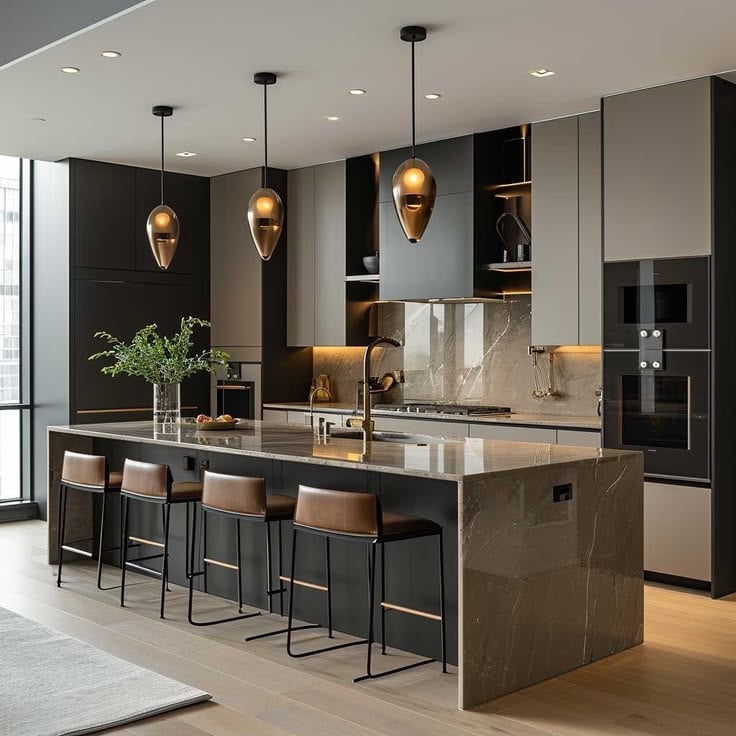
What makes an island 'sculptural' in 2026 is the combination of contrasting materials, curved geometry, and integrated function at a scale that previous kitchen design rarely attempted. The island top might be a single book-matched slab of dramatic natural quartzite or marble. The base might be clad in a contrasting material — natural walnut, fluted stone, hand-applied limewash plaster, or bronzed metal — that creates a furniture-like quality entirely separate from the perimeter cabinetry. Curved ends and rounded corners have replaced the strictly rectangular island of the 2010s, adding a softness that references the organic forms of luxury hospitality design.
Function follows the form: the 2026 luxury island integrates a prep sink (often unlacquered brass or brushed nickel with an architectural profile), a recessed induction cooktop or gas burner, undercounter refrigeration drawers, concealed charging stations, and a waterfall edge that drops to seating height on one side. The result is a piece that serves as prep station, social gathering point, dining surface, and design statement simultaneously.
Trend 6: Smart Technology — Invisible, Intuitive, Essential
Smart kitchen technology crossed a threshold in 2026 that separates it from the 'feature' category and places it in the 'expectation' category for luxury buyers. C&C Partners' January 2026 custom home trend analysis identifies this shift precisely: 'Smart kitchen technology has moved beyond flashy displays and obvious gadgets. In 2026, the most luxurious custom home kitchens seamlessly integrate technology that enhances functionality without disrupting aesthetics.'
The key word is seamlessly. The luxury kitchen buyer in 2026 does not want a touchscreen on the refrigerator door or LED lighting strips announcing their presence. They want a refrigerator with an interior camera that allows remote grocery monitoring — viewable on a phone during shopping — without any visible interface on the exterior. They want a faucet that dispenses an exact measurement of water at the right temperature via voice command, without any visible controls. They want the HVAC system, the under-cabinet lighting, the window shades, and the appliances to respond to a single smart home platform, invisibly and without friction.
Smart Kitchen Technology: What Luxury Buyers Expect in 2026 ✓ Interior-camera refrigeration (Sub-Zero, Miele): View contents remotely via smartphone; no exterior display ✓ Voice-activated faucets: Precise volume/temperature dispensing via voice command (Kohler Sensate, Brizo) ✓ Induction cooktops with zone flexibility: No fixed burner positions; full-surface cooking intelligence ✓ Smart ovens with remote preheat and probe monitoring: Gaggenau, Wolf M Series, Miele Dialog Oven ✓ Integrated dishwashers with AutoDos automatic detergent dispensing (Miele) ✓ Under-cabinet and in-cabinet lighting linked to circadian rhythm schedules ✓ Single-platform smart home control: Kitchen appliances, lighting, HVAC, and blinds on one system ✓ Motorized storage: Pull-out shelves, corner units, and pantry systems with motorized lift mechanisms ✓ Built-in charging drawers and pop-up power stations concealed within the island |
GH Cabinetry's analysis from February 2026 frames this well: 'Smart kitchens are no longer a trend — they're becoming a necessity in luxury homes.' Smart refrigerators, AI-capable appliances, and voice-activated systems 'offer convenience and efficiency while maintaining a sleek, modern design.' The operative phrase is 'maintaining sleek, modern design' — the technology earns its place only when it disappears into the kitchen's visual fabric.
Trend 7: Appliance Brands — The Definitive 2026 Hierarchy
In a $3M–$6M custom kitchen, the appliance specification is as important as the countertop material or the cabinetry finish. The brands that anchor a luxury kitchen communicate immediately to the informed buyer what level of performance, craftsmanship, and design consciousness the owner brought to the project. Yale Appliance's March 2026 comprehensive brand analysis identifies the current landscape with precision:
Brand | Best Known For | Price Range | Standout Feature |
Sub-Zero / Wolf / Cove | Refrigeration + full suite | $8K–$25K+ per unit | Dual-compressor fridge; Wolf dual-stack burners; Cove ultra-quiet dishwasher |
Gaggenau | Design + precision | $5K–$30K+ per unit | Avant-garde design; restaurant-grade precision; European kitchen standard |
La Cornue | Artisanal craftsmanship | $8K–$50K+ per range | Each handcrafted by a single artisan; Chateau Series; fully customizable color |
Miele | Dishwashers + full suite | $3K–$15K+ per unit | Rated #1 dishwashers; AutoDos system; 20-year product lifespan |
Thermador | Innovation + value | $4K–$20K per unit | Star Burner ranges; Freedom induction cooktops; integrated refrigeration columns |
BlueStar | Color + cooking power | $3K–$12K per range | 9-10 color rating; natural gas performance; chef-level BTU output |
Viking | Power + statement | $3K–$15K per unit | Bold professional aesthetic; maximum BTU; color variety |
Yale Appliance's 2026 brand hierarchy is direct: 'Sub-Zero is king for refrigeration. Wolf and BlueStar are the heavy hitters for ranges. Gaggenau and Wolf stand out for wall ovens. Miele is a 10 for dishwashers.' JustLuxe's comparison adds the cultural context: 'There is no single best brand — Sub-Zero/Wolf/Cove leads in integration, Gaggenau in design, Thermador in innovation, Viking in power, and La Cornue in craftsmanship.' For buyers building or renovating a $3M+ kitchen, the specification typically combines Sub-Zero or Gaggenau refrigeration, Wolf or La Cornue for the range, and Miele for the dishwasher — a suite that covers the spectrum of performance excellence.
The defining aesthetic shift across all brands in 2026 is what Friedman's Appliance describes as the 'quiet luxury trend toward integrated refrigeration and handle-less cabinetry.' Appliances are panel-fronted, flush with the cabinetry, invisible unless you know where to look. The Sub-Zero column refrigerator behind a walnut panel front is a $15,000 investment that, by design, you cannot see. That invisibility is the point — and the hallmark of a kitchen where every decision was made for the right reasons.
Trend 8: Mixed Metals and Contrasting Finishes
The era of matching hardware is over. C&C Partners' January 2026 trend analysis identifies the mixing of metals and contrasting finishes as one of the defining characteristics of the year's most celebrated custom kitchen designs: 'Gone are the days when every fixture needed to match perfectly. Architectural design firms are embracing mixed metals and contrasting finishes to add depth and visual interest.'
The most sophisticated combinations in 2026 pair brushed brass hardware on cabinetry with matte black faucets, or polished nickel pendant lighting with aged bronze range hood detailing. Unlacquered brass — which develops a natural patina over time, darkening and gaining depth with use — is having a significant moment, particularly in kitchens with warm wood cabinetry where its organic quality feels intentional rather than trendy. The key principle, as C&C notes, is 'maintaining a cohesive palette and ensuring finishes complement rather than clash.' Mixed metals work when there is a clear hierarchy: one dominant finish (typically on the largest surface, such as the range hood or island pendants) and one or two complementary accents.
- Dominant combinations in 2026: Brushed brass + matte black | Unlacquered brass + brushed stainless | Satin nickel + warm bronze | Polished chrome + aged iron
- What to avoid: More than three metal finishes in a single space. Chrome and gold in the same kitchen. Overly bright, high-polish finishes in a space designed around matte materials.
Trend 9: Lighting — Architecture of Atmosphere
Lighting in the luxury kitchen has evolved from a functional consideration to an architectural one. L'Atelier Paris's 2026 guide describes the shift: 'Chandeliers and artistic pendant lights create ambiance and highlight key areas. Layered lighting — ambient, task, and accent — is essential to elevate the overall aesthetic.' The 2026 luxury kitchen is lit in three distinct layers, each serving a different purpose and each contributing to the space's overall atmosphere.
- Ambient lighting: Recessed fixtures with dimmer controls and warm color temperature (2700–3000K) establish the room's overall light level. In 2026, these are tunable: color temperature adjusts from warm morning light to cooler midday brightness, programmed to circadian rhythm schedules.
- Task lighting: Under-cabinet LED strips integrated directly into the cabinetry above the prep and cooking zones. In 2026, these are concealed inside the cabinet profile — no visible strip, only the light it produces.
- Statement lighting: The pendant lights or chandelier above the island are one of the kitchen's most visible design decisions. In 2026, the trend favors artisanal pendants in blown glass, wrapped rattan, hand-formed metal, or architectural sculptural forms — pieces with genuine design provenance rather than catalog selections.
- Accent lighting: In-cabinet lighting for glass-front uppers, toe-kick lighting at floor level, and interior refrigerator lighting that activates on door opening — all adding depth and dimension to the space after dark.
Trend 10: Flooring — Premium Materials with Visual Continuity
Flooring in the luxury kitchen is increasingly treated as part of the home's continuous material palette rather than a separate utilitarian decision. L'Atelier Paris identifies the dominant materials: 'Premium flooring options like reclaimed wood, large-format porcelain tiles, limestone, or polished concrete dominate luxury homes. These materials provide durability along with stunning visual continuity, tying the entire kitchen together.'
Large-format porcelain tile — slabs up to 120 x 60 inches with minimal grout lines — creates an almost seamless floor that reads as a single material surface. When specified in a warm stone or concrete appearance, it visually extends the countertop material to the floor level, creating the layered warmth that defines the best 2026 kitchens. Reclaimed wide-plank hardwood — typically white oak or French oak — brings warmth and historical depth to kitchen spaces open to living and dining areas, where a single flooring material flows continuously from one space to the next. Limestone and travertine continue to appear in kitchens with a European or Mediterranean design character, where their natural variation and warmth complement aged brass fixtures and limewash cabinetry.
Trend 11: Sustainable Luxury — Thoughtful Materials for the Conscious Buyer
Sustainability has entered the luxury kitchen not as a compromise but as a genuine design value. GH Cabinetry's February 2026 analysis identifies it as a 'pivotal role in luxury design' in 2026, with 'energy-efficient appliances, eco-friendly materials, and luxury kitchens that prioritize sustainability without sacrificing aesthetics.'
The sustainable luxury kitchen in 2026 makes its commitments visible in the materials: reclaimed wood cabinetry with documented provenance, bamboo veneer panels, low-VOC and water-based paint finishes on cabinetry, locally quarried stone that reduces transport impact, and recycled glass countertop elements used as accent surfaces. On the appliance side, Miele's and Sub-Zero's energy efficiency ratings lead the luxury category — the Sub-Zero's dual-compressor technology extends food freshness significantly, reducing waste, while Miele's dishwashers operate at industry-leading water and energy efficiency per cycle. George Cabinetry notes that 'water-efficient fittings' and 'energy-monitoring refrigerators' are specifically sought by the eco-conscious luxury buyer cohort.
Trend 12: Open Living Integration and the Indoor-Outdoor Kitchen
The final defining trend of 2026 is the complete dissolution of the boundary between the kitchen and the living environment — and, in climates and homes that allow it, between the kitchen and the outdoors. Mercury Builders' April 2026 luxury kitchen design analysis is direct: 'Open-concept kitchens remain the dominant choice in high-end remodels in 2026. Removing partition walls and integrating the kitchen with dining and living areas creates flow, improves natural light, and dramatically changes how a home feels.'
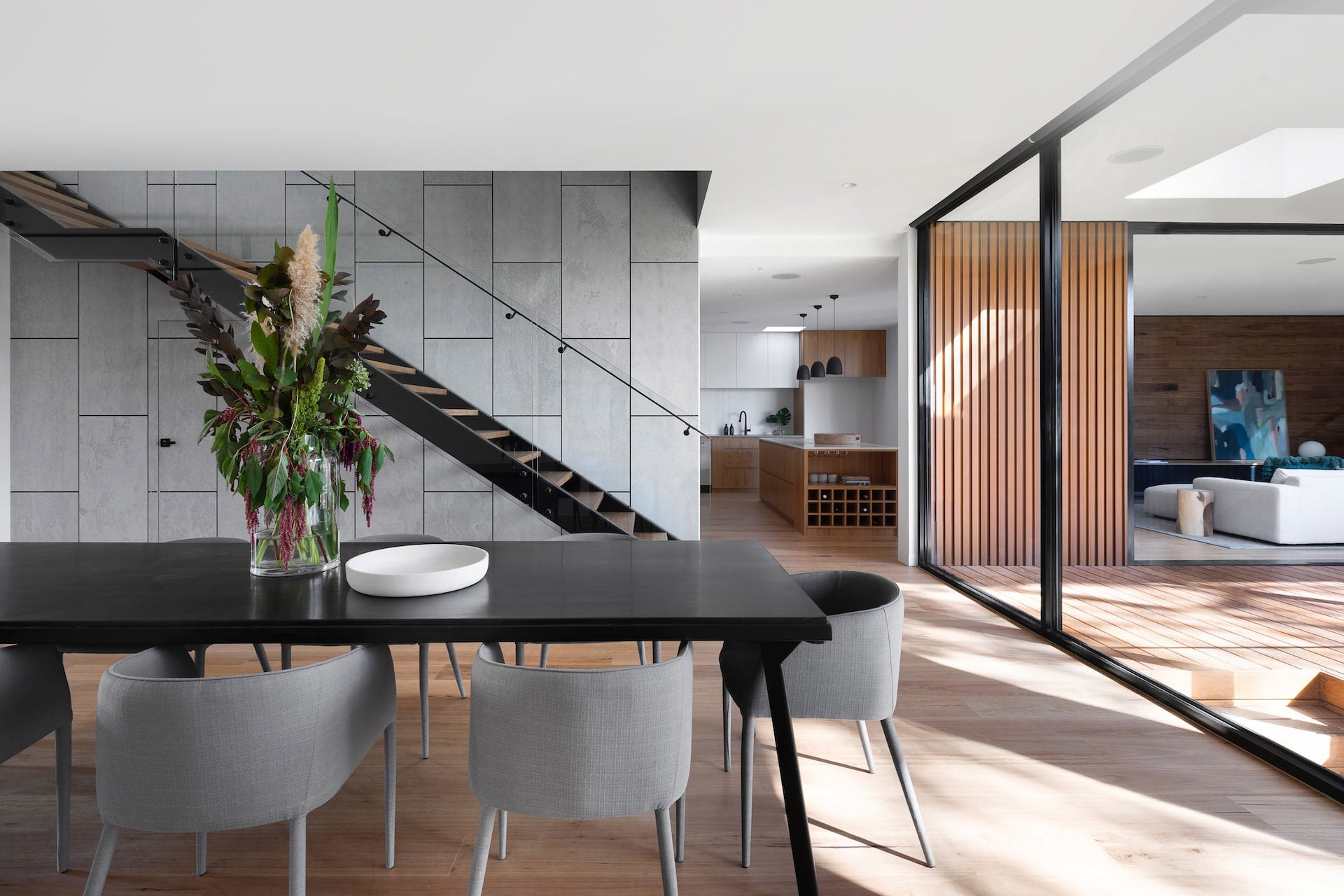
At the highest level of luxury residential design — the North Ridge estates, the Parade of Homes-quality custom builds, the Hayes Barton renovations where walls are removed to restore flow to historic floor plans — the kitchen does not exist in isolation. It is a coordinated extension of the living and dining experience. The island becomes the transition point between the cooking zone and the social space. The material palette flows continuously from kitchen through dining through living room — the same stone, the same wood, the same metal finishes appearing in each space at different scales.
The indoor-outdoor kitchen — confirmed by the Southwest Florida luxury market as a 'given' in 2025-2026 and increasingly standard in NC's mild climate zones — extends this logic to the exterior. A covered outdoor kitchen with a Wolf or Kalamazoo grill, an undercounter refrigerator, a pizza oven, and a full bar sink connects to the primary interior kitchen through folding or sliding glass walls that disappear into the architecture when open. The covered terrace becomes a third cooking and entertaining environment, activated from spring through fall in North Carolina's climate. In North Ridge estates with pool houses and golf course-fronting terraces, the outdoor kitchen has become as considered as the interior one.
The most celebrated luxury kitchens of 2026 are not rooms. They are ecosystems — spaces that flow from interior to exterior, from primary kitchen to scullery, from prep zone to social gathering point, designed as a unified whole and executed with the precision of the finest architecture.
What These Trends Mean for Raleigh's Luxury Market
In Raleigh's $3M–$6M custom build and estate renovation market, the kitchen trends described in this guide are not aspirational — they are already present in the most competitive inventory. The North Ridge Parade of Homes properties by Raleigh Custom Homes, AR Homes, and ICG Homes consistently showcase natural quartzite countertops, panel-front Sub-Zero or Gaggenau refrigeration, sculleries or prep kitchens adjacent to the primary entertaining space, sculptural waterfall islands with contrasting base materials, and layered lighting systems with smart home integration. These are not features that are coming to Raleigh's luxury market — they are already the baseline expectation for buyers at this price point.
For buyers evaluating $3M–$6M properties in North Ridge, Hayes Barton, and Country Club Hills, the kitchen specification is one of the clearest signals of build quality and design intention. A kitchen with natural quartzite, Wolf or Sub-Zero appliances, custom walnut cabinetry, and a properly designed scullery communicates that the builder and owner made decisions at every stage for the right reasons. A kitchen that shortcuts any of these elements — generic granite, box-store cabinetry, builder-grade appliances — communicates the opposite, regardless of what the square footage says.
For sellers preparing a luxury property for the market, the kitchen is the investment most likely to return its cost at sale. A $150,000 to $250,000 kitchen renovation — properly specifying quartzite, custom cabinetry, and Sub-Zero/Wolf/Miele appliances — in a $2.5M–$4M home is one of the highest-return single investments in luxury real estate. The kitchen is what serious buyers photograph, what they remember, and what they use to anchor their perception of the entire home's quality. Get it right, and the rest of the showing follows. Get it wrong, and no amount of living room staging will compensate.
The Bottom Line: The 2026 Luxury Kitchen as a Design Philosophy
The twelve trends in this guide are not independent from each other — they are expressions of a single, coherent design philosophy that defines the best luxury kitchens of 2026. Quiet luxury. Intentional materials. Technology that serves without intruding. Spaces that flow between functions and between indoor and outdoor environments without friction. The scullery that preserves the primary kitchen's beauty. The quartzite that ages beautifully. The Sub-Zero that disappears behind walnut. The brushed brass that develops patina over a decade of use.
These are not trends in the fleeting sense. They are the evolution of luxury residential design toward something permanent: kitchens that are fully bespoke, fully functional, and fully expressive of the life that happens inside them. In Raleigh's most prestigious addresses, where custom builds are setting new price records and discerning buyers are arriving from the country's most sophisticated markets, this is the standard. And it is only getting higher.
Sources: L'Atelier Paris Haute Design (2026) · George Cabinetry (Apr 2026) · GH Cabinetry (Feb 2026) · C&C Partners (Jan 2026) · House Digest (Jan 2026) · Yale Appliance (Mar 2026) · JustLuxe (May 2026) · Mercury Builders (Apr 2026) · Friedmans Appliance (May 2026) · Byrd Design & Build (Nov 2025) · Margetts Kitchens (Aug 2025) · Kitchen
Check out this article next